
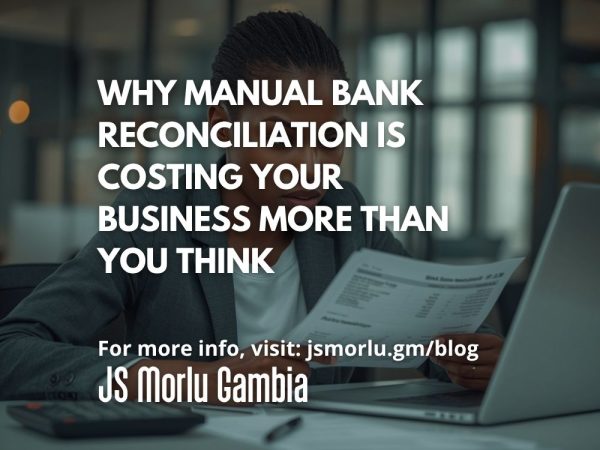
At the end of every month, someone in the business sits down with a bank statement in one hand and the accounting records in the other, checking that every transaction matches. For many businesses in The Gambia, this process — reconciliation — is still done entirely by hand.
Reconciliation isn’t optional. It’s the process that confirms your records actually reflect what happened in your bank account — but doing it manually is where most of the pain comes from.
What Reconciliation Is Actually Checking
Reconciliation compares two sets of records — your internal books and your bank statement — to confirm they agree. Every deposit, withdrawal, fee, and transfer should appear in both places, matched correctly. When they don’t match, it usually means something was recorded incorrectly, a transaction was missed, or in rarer cases, there’s an error or discrepancy that needs investigating.
Where Manual Reconciliation Breaks Down
The problem isn’t that reconciliation is hard conceptually — it’s that doing it manually doesn’t scale as transaction volume grows. A business processing a handful of transactions a month can reconcile by hand without much trouble. A business processing hundreds, across multiple accounts or payment channels, faces a task that consumes days rather than hours.
Manual matching also introduces exactly the kind of human error the process is meant to catch — a transposed number, a missed entry, a transaction matched to the wrong line. These errors often go unnoticed until they compound into a bigger discrepancy later.
The Real Cost Isn’t Just Time
Beyond the hours spent, delayed or inaccurate reconciliation has downstream effects: financial reports built on unreconciled data are less reliable, cash position estimates can be wrong, and discrepancies that go unnoticed for months are far harder to trace back to their source than ones caught immediately.
A business that reconciles accurately and quickly has a genuinely clearer, more current picture of its own financial position than one still catching up on last month’s numbers.
How Automated Reconciliation Changes the Process
Tools like ReckSoft use AI-driven matching to compare transactions across systems automatically, flagging discrepancies in seconds rather than requiring someone to manually cross-check every line. This doesn’t remove the need for human review entirely — someone still needs to investigate flagged discrepancies — but it removes the repetitive, error-prone matching work that consumes the most time.
For businesses handling reconciliation across multiple accounts, currencies, or payment platforms, this shift from manual to automated matching is often the difference between reconciliation being a monthly burden and a routine, low-effort check.
JS Morlu Gambia is a professional accounting firm and property valuation specialist based at Salameh Complex, Sukuta Highway, Brusubi, Kombo North, West Coast Region, The Gambia. We serve businesses, NGOs, and institutions across Banjul, Serekunda, Brikama, and throughout the country with structured financial reporting, compliance support, independent property valuation, and coordinated audit assistance designed to strengthen financial transparency and support sustainable growth.