
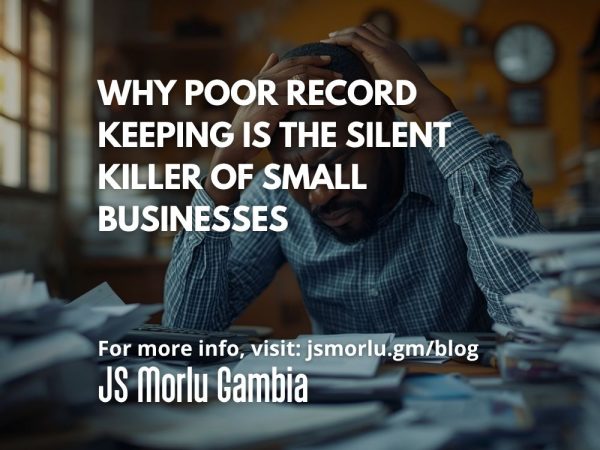
Every year, businesses in The Gambia close not because they lacked customers, not because their product was poor, and not because the owner did not work hard enough. They close because the financial foundation was not there. And in most cases, the cracks in that foundation started with poor record keeping.
Record keeping is not a glamorous topic. It does not generate revenue or attract clients. However, it is the infrastructure that everything else in a business depends on — and when it fails, the consequences ripple across every aspect of financial management.
What Poor Record Keeping Actually Looks Like
Poor record keeping is not always obvious from the outside. A business can appear to be running smoothly while its financial records are in a state that would cause serious problems if examined closely.
Common signs include transactions that are not recorded when they happen, receipts that are lost or never collected, bank accounts that have not been reconciled for months, expense categories that are mixed together without clear separation, and financial reports that take weeks to produce because the underlying data is not organised.
Each of these issues seems manageable in isolation. However, together they create a picture of a business that does not know its own financial position — which limits every decision the owner makes.
How Poor Records Affect Cash Flow
Cash flow problems are one of the most direct consequences of poor record keeping. When income and expenses are not tracked in real time, it is impossible to know the current cash position accurately. Payments that are due from customers may be forgotten or chased too late. Expenses may be committed without a clear view of whether the funds are there to cover them.
The result is a business that is constantly reacting to cash flow pressure rather than anticipating and managing it. Many business owners describe this as a feeling of always being short — even when revenue appears to be strong.
The Impact on Financing Opportunities
Banks and other lenders in The Gambia require financial statements before approving any significant financing. When records are poor, producing those statements is either impossible or requires weeks of catching up on bookkeeping that should have been done throughout the year.
More significantly, records that have been reconstructed under pressure are less reliable than records that have been maintained consistently. Lenders know this. A business that cannot produce clean, current financial records is a higher-risk borrower — and will either be declined or offered less favourable terms as a result.
The Compounding Effect Over Time
One of the most damaging aspects of poor record keeping is that it compounds over time. A month of incomplete records leads to a quarter of incomplete records, which leads to a year that cannot be properly accounted for.
By the time most business owners in The Gambia realise the records need to be addressed, the volume of work required to bring them up to standard is significant. The cost — in accountant fees, in management time, and in the decisions that were made with incomplete information — is almost always higher than the cost of maintaining good records would have been.
Building Better Habits
Improving record keeping does not require a complex system or expensive software. It requires consistency. Recording transactions when they happen, collecting and filing receipts immediately, reconciling bank accounts monthly, and reviewing financial reports regularly are habits that any business can develop.
The businesses in The Gambia that manage their finances most effectively are rarely the ones with the most sophisticated systems. They are the ones that do the basic things consistently — and build on that foundation as the business grows.
The Real Cost of Doing Nothing
Poor record keeping has a cost that most business owners never calculate. It is the financing they could not access, the decisions they made with incomplete information, the tax position they could not optimise, and the time spent in crisis management that better systems would have prevented. That cost is almost always higher than people expect — and it is entirely avoidable.
JS Morlu Gambia is a professional accounting firm and property valuation specialist based at Salameh Complex, Sukuta Highway, Brusubi, Kombo North, West Coast Region, The Gambia. We serve businesses, NGOs, and institutions across Banjul, Serekunda, Brikama, and throughout the country with structured financial reporting, compliance support, independent property valuation, and coordinated audit assistance designed to strengthen financial transparency and support sustainable growth.