
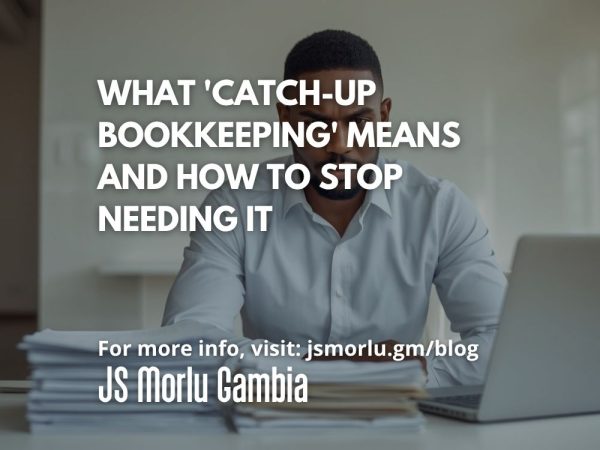
A business owner had not touched his books in six months. Receipts were stuffed into one growing folder, untouched.
Catching up meant reconstructing half a year of transactions from memory and paper.
What Catch-Up Bookkeeping Actually Means
Catch-up bookkeeping is exactly what it sounds like, going back through months of unrecorded transactions and entering them properly, after the fact.
It is slower and harder than keeping records as you go, because details fade and documents get lost the longer they sit unentered.
Why Businesses End Up Needing It
- Bookkeeping gets pushed aside during busy periods, then never resumed
- A system feels complicated, so entries pile up untouched
- Nobody is clearly responsible for keeping records current
- Small gaps turn into large ones before anyone notices the backlog
What This Looks Like in Practice
The business owner’s six-month catch-up took weeks of work. Several receipts were missing entirely, and some transactions had to be reconstructed from bank statements alone.
What would have taken an hour a week, done consistently, instead took an entire month to untangle.
A Second Example: The Repeat Backlog
A different owner caught up once, then fell behind again within a few months. Catching up had fixed the backlog, but nothing had changed about the habits that created it.
The second catch-up was just as painful as the first.
Why Ongoing Reconciliation Is the Real Fix
A one-time catch-up solves the immediate problem. It does not solve the pattern behind it. What actually prevents a repeat backlog is a system that reconciles continuously, not in occasional bursts.
This is exactly where a structured system like FinovatePro changes the pattern. Transactions get matched as they happen. An accountant can access the books directly, instead of waiting for a folder to be handed over months later.
A Simple Way to Avoid a Repeat
Once your books are caught up, set a fixed weekly time to enter and reconcile transactions, no matter how small the week’s activity was.
A small habit kept every week is what actually prevents the next six-month backlog from forming.
What to Expect During a Catch-Up
A proper catch-up usually starts with gathering every available document, bank statements, receipts, and invoices, even incomplete ones.
From there, transactions get entered and reconciled in order, oldest first, until the records are fully current and match the actual bank balance.
Why Businesses Delay Asking for Help
Many owners wait to ask for help because the backlog feels embarrassing, as if falling behind reflects poorly on how the business is run.
In practice, catch-up bookkeeping is common enough that it rarely surprises anyone handling it professionally. Waiting longer only makes the eventual catch-up harder.
What Changes Once the Backlog Is Cleared
Once records are current, decisions get easier. Owners can see real numbers instead of guessing, and conversations with lenders or partners no longer start with an apology about outdated books.
That shift in confidence is often as valuable as the records themselves.
Why the System Matters as Much as the Fix
Clearing a backlog without changing the underlying system usually means facing the same problem again within a year. The system is what keeps the fix permanent.
That is the real difference between catching up once and never needing to catch up again.
Who Actually Needs This Service
Catch-up bookkeeping is not only for businesses in serious trouble. Many healthy, growing businesses simply fell behind during a busy period and never found the time to return to it.
Recognizing that early keeps a backlog from becoming a bigger problem. Waiting until a lender or auditor forces the issue only makes it worse.
How JS Morlu Gambia Can Help
JS Morlu Gambia helps you catch up on months of unentered records. We then set you up with FinovatePro, so your books stay current through ongoing reconciliation and simple accountant access. The goal is not just fixing the backlog, but making sure it never builds up again.
JS Morlu Gambia is a professional accounting firm and property valuation specialist based at Salameh Complex, Sukuta Highway, Brusubi, Kombo North, West Coast Region, The Gambia. We serve businesses, NGOs, and institutions across Banjul, Serekunda, Brikama, and throughout the country with structured financial reporting, compliance support, independent property valuation, and coordinated audit assistance designed to strengthen financial transparency and support sustainable growth.