
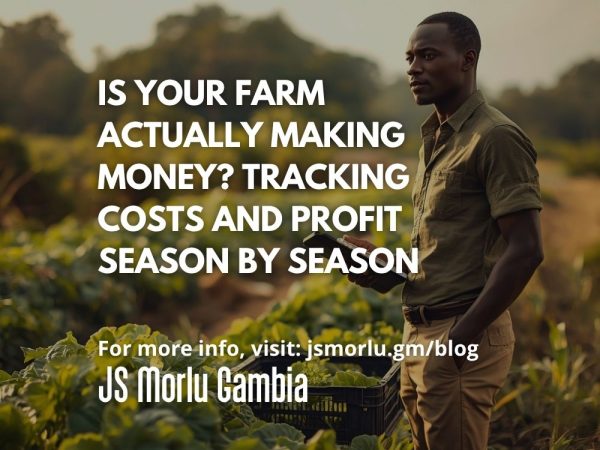
A farmer had his best harvest in years. Everyone said so.
When he actually added up his costs, the profit was barely there.
Why a Big Harvest Can Still Mean Small Profit
A larger harvest often comes with larger costs attached. More seed, more labor, more transport to get everything to market.
Volume and profit are not the same measurement. One counts what came out of the ground. The other counts what is left after paying for it.
Costs That Are Easy to Underestimate
- Seeds and fertilizer, especially when prices shift from one season to the next
- Labor, including family members helping without a formal wage recorded
- Transport and storage losses between the field and the market
- Equipment repairs and maintenance spread across the season
What This Looks Like in Practice
The farmer tracked his harvest volume closely every season. He had never tracked his costs with the same attention.
Once he added them up properly, the picture changed. A season that felt like a clear success turned out to have a thin margin once everything was accounted for.
A Second Example: The Season That Looked Worse Than It Was
A different farmer had a smaller harvest one season and assumed it was a weak year. Once costs were tracked properly, that smaller harvest actually produced a better profit margin than the bigger one the year before.
Lower rainfall had meant lower pest costs and less wasted produce. The smaller season was quietly the more profitable one.
Common Mistakes to Avoid
- Judging a season by harvest size alone, without tracking costs alongside it
- Leaving family labor untracked, even when it has a real economic value
- Mixing costs from different seasons together instead of tracking them separately
- Only reviewing finances once a year, long after each season has ended
A Simple Habit Worth Building
Keep a simple season-by-season record: total costs on one side, total income on the other. Compare the margin season to season, not just harvest size to harvest size.
That comparison tells you which seasons, and which crops, are actually worth repeating.
Why This Matters for Future Decisions
Season-by-season records help answer questions a single year of totals cannot. Which crop actually performed best once costs are accounted for? Which season is worth expanding, and which is worth scaling back?
Without that detail, a farmer is left guessing based on feeling rather than on what the numbers actually show.
What to Do With Family Labor
Family members helping on the farm often go unpaid and unrecorded. Even an estimated value for their time gives a more honest picture of what a season truly costs.
Leaving it out does not make the cost disappear. It only hides it from the final number.
Building a Record That Works for a Farm
A farm record does not need to look like a formal accounting ledger. A simple notebook, split by season and by crop, is often enough to start.
What matters most is capturing both sides consistently, every cost paid out and every amount earned, season after season, in the same format each time.
Using the Record to Plan Ahead
Once a few seasons are tracked properly, patterns start to emerge. Certain crops may consistently perform better, or certain costs may consistently eat into margins more than expected.
That pattern is far more useful for planning the next season than relying on how the last harvest simply felt at the time.
Even two or three seasons of honest records can reshape decisions that used to rest entirely on instinct.
A good harvest will always feel good in the moment. The numbers are what tell you whether that feeling was actually right.
How JS Morlu Gambia Can Help
JS Morlu Gambia helps farming businesses track costs and income by season, so you can see which crops and which periods are actually profitable. We help turn that insight into clearer decisions for the next planting cycle.
JS Morlu Gambia is a professional accounting firm and property valuation specialist based at Salameh Complex, Sukuta Highway, Brusubi, Kombo North, West Coast Region, The Gambia. We serve businesses, NGOs, and institutions across Banjul, Serekunda, Brikama, and throughout the country with structured financial reporting, compliance support, independent property valuation, and coordinated audit assistance designed to strengthen financial transparency and support sustainable growth.