
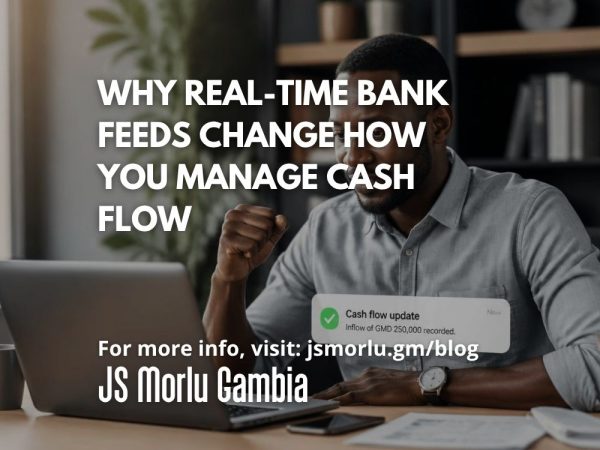
A business owner found out he was short on payroll two days before payday. If his system had shown him the gap a week earlier, he’d have had time to act.
What a Real-Time Bank Feed Actually Does
Instead of manually checking a balance or waiting for a monthly statement to arrive, a connected bank feed pulls transactions into the accounting system automatically, often within the same day they happen. What used to be a periodic check-in becomes a continuous, live picture of where the business actually stands.
What This Changes in Practice
- Cash position reflects what’s actually happening right now, not a snapshot from whenever someone last logged in to check
- Unusual or unexpected transactions get noticed almost immediately, rather than surfacing weeks later during a routine review
- Reconciliation happens continuously in small pieces instead of piling up into a stressful task at month-end
- Shortfalls become visible days or weeks before they’d otherwise be discovered, while there’s genuinely enough time to respond
Why Manual Checking Falls Short
The problem with manual checking isn’t that owners are careless. It’s that checking a balance takes effort, and effort competes with everything else demanding attention in a given week. A weekly or monthly glance at the bank balance can miss a slow, steady decline that would have been obvious if it were visible continuously instead of in occasional snapshots.
A Common Mistake
Treating cash flow as something to check when it feels necessary, rather than something the system should be surfacing on its own. By the time a manual check finally reveals a problem, the window to respond calmly has often already narrowed to something closer to a scramble, moving money between accounts, delaying a payment, calling a client to chase an overdue invoice under real pressure.
What This Looks Like in Practice
His new system flagged a declining cash trend a full week before his old manual process would have caught it. That week made the difference between a calm decision and a crisis. He delayed a non-essential equipment purchase, moved up a client payment he’d normally have let ride, and covered payroll without needing to scramble for a short-term loan or dip into funds set aside for something else.
Setting It Up Doesn’t Need to Be Complicated
Most modern accounting systems support a direct bank feed as a standard feature, not an expensive add-on. The setup itself is usually quick. The larger shift is behavioral: trusting the system enough to stop manually re-checking a balance that’s already being tracked automatically, and instead reacting to the alerts and trends the system surfaces on its own.
What to Watch For Once It’s Running
A live feed is only useful if someone actually looks at what it’s showing. Setting a simple threshold, an alert if the balance drops below a certain level, or if outgoing payments in a week exceed a set amount, turns a passive data stream into something that actively flags problems. Without that step, a real-time feed just becomes a more detailed version of the same balance owners were already glancing at occasionally. The value comes from pairing the live data with a habit, even a brief one, of actually reviewing what it’s telling you.
It also changes how far ahead a business owner can plan. A weekly balance check tells you where things stand today. A live trend line tells you where things are headed, days or weeks before the number itself becomes a problem. That difference, seeing the slope rather than just the snapshot, is often what separates a calm adjustment from a last-minute scramble.
How JS Morlu Gambia Can Help
JS Morlu Gambia sets up structured accounting systems with real-time bank feeds built in, so your cash position stays consistently current instead of something you check after the fact. We also help you set up simple alerts for exactly the thresholds that matter to your business.
JS Morlu Gambia is a professional accounting firm and property valuation specialist based at Salameh Complex, Sukuta Highway, Brusubi, Kombo North, West Coast Region, The Gambia. We serve businesses, NGOs, and institutions across Banjul, Serekunda, Brikama, and throughout the country with structured financial reporting, compliance support, independent property valuation, and coordinated audit assistance designed to strengthen financial transparency and support sustainable growth.