
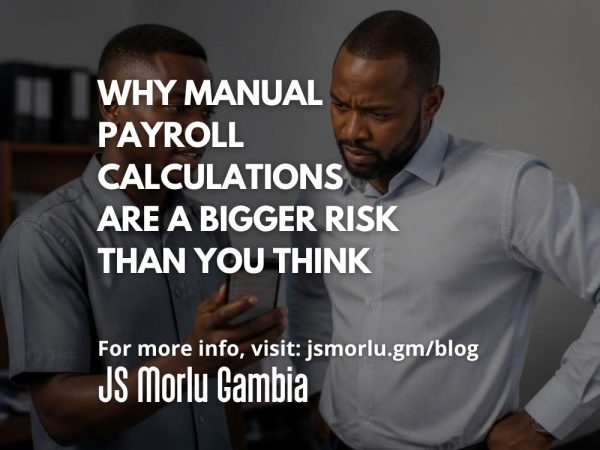
A business owner calculated payroll by hand every month for three years. He caught the error only when an employee mentioned their pay looked different from usual.
Payroll feels straightforward until a spreadsheet formula breaks quietly, or a rate change doesn’t get updated everywhere it should. By the time someone notices, it’s often been wrong for a while.
Why Manual Payroll Is Riskier Than It Feels
Payroll involves more moving parts than most owners realize. Overtime rates, deductions, allowances, each one is a separate calculation that has to stay correct every single pay period.
A single formula error can repeat itself for months without anyone catching it. Unlike a one-time mistake, payroll errors compound silently in the background.
What Commonly Goes Wrong
- A copied formula that doesn’t update correctly when a new employee is added to the sheet
- A rate change applied to some employees but missed for others
- Manual rounding errors that seem tiny individually but add up across a full team
- No clear record of what changed and when, making errors hard to trace later
Why These Errors Are Expensive
Underpaying an employee damages trust and can create legal exposure. Overpaying quietly drains money that’s difficult to recover once it’s been paid out.
Either direction carries real cost, and manual processes make both more likely.
What This Looks Like in Practice
The business owner’s spreadsheet had a formula that stopped updating correctly after he added a new employee row. It threw off overtime calculations for two other staff members for several months.
Nobody noticed until an employee brought it up directly. The correction required going back through months of pay records, a task that took days to untangle properly.
A Second Example: The Cost of a Missed Rate Change
Formula errors aren’t the only risk. A different business owner updated the minimum wage rate for most of his staff after a policy change, but missed three part-time employees on a separate section of the sheet.
Those three employees were underpaid for nearly two months before one of them raised it. Beyond the back pay owed, the business owner had to spend time explaining what happened and rebuilding trust with staff who reasonably wondered whether it had happened to them before, too.
The error itself was small in dollar terms. The damage to trust took much longer to repair than the correction to the numbers did.
Common Mistakes That Make This Worse
- Keeping payroll formulas in the same sheet used for other calculations, increasing the chance of accidental changes
- Having only one person who understands how the payroll sheet actually works
- Skipping a second check before payments go out, especially after any staff or rate changes
- Not keeping a record of previous pay periods to compare against for consistency
A Simple Way to Reduce the Risk
A structured payroll system recalculates automatically and flags unusual changes before they go out. It removes the manual copying and formula-dragging that causes most of these errors in the first place.
What a Transition Actually Looks Like
Moving away from a manual spreadsheet doesn’t need to happen all at once. Many businesses start by running the new system alongside the old one for a single pay cycle, comparing the two results before fully switching over.
That overlap period catches any setup mistakes early, before the manual process is retired completely. Once the numbers match consistently across a couple of cycles, most owners feel comfortable relying on the new system on its own.
It also gives staff time to get comfortable with a new process without the pressure of it being the only option available yet, which tends to make the eventual full switch far less disruptive.
How JS Morlu Gambia Can Help
JS Morlu Gambia sets up structured accounting systems with payroll processes built in, reducing the manual steps where errors typically creep in. We also help you build a simple review step before payroll goes out each cycle.
JS Morlu Gambia is a professional accounting firm and property valuation specialist based at Salameh Complex, Sukuta Highway, Brusubi, Kombo North, West Coast Region, The Gambia. We serve businesses, NGOs, and institutions across Banjul, Serekunda, Brikama, and throughout the country with structured financial reporting, compliance support, independent property valuation, and coordinated audit assistance designed to strengthen financial transparency and support sustainable growth.