
By: Moses V. Kowo, MBA
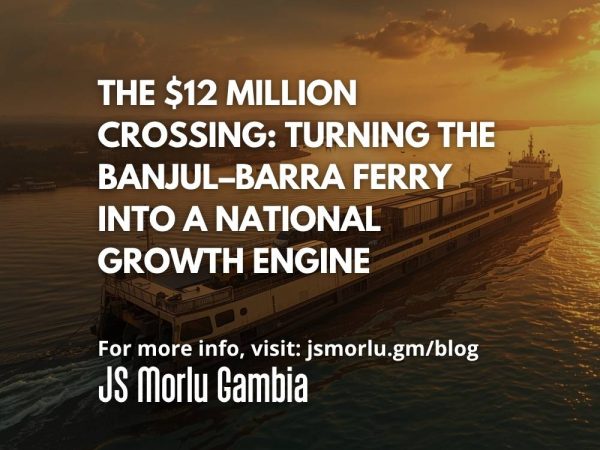
When President Adama Barrow commissioned the $12 million hybrid ferry connecting Banjul and Barra, public discussion largely focused on easing transport congestion.
But the real significance of this investment goes far beyond transportation.
The ferry represents a strategic opportunity to address one of The Gambia’s most persistent economic constraints: the high cost, uncertainty, and delays involved in moving people and goods across the River Gambia. If managed effectively, this single infrastructure asset could significantly increase national productivity, strengthen trade flows, and unlock millions of dollars in economic value each year.
However, infrastructure alone does not guarantee economic impact. The difference between a transformative national asset and an underperforming project lies in financial controls, operational systems, and governance discipline.
The Banjul–Barra Crossing: A Longstanding Economic Bottleneck
The Banjul–Barra route is more than a geographic crossing—it is a vital economic corridor connecting the capital region with the North Bank.
Before the introduction of the new ferry, the crossing presented several operational challenges:
- Vehicles often waited for hours, sometimes half a day
- Perishable agricultural goods lost value before reaching markets
- Transport costs increased due to idle fuel consumption and driver time
- Tourism experiences were negatively affected by unpredictability
From an economic perspective, this corridor functioned as a high-friction system—a hidden tax on trade and mobility. When delays and uncertainty become normal, businesses adjust their behavior by limiting activity, reducing investment, or absorbing additional costs.
Over time, these inefficiencies quietly reduce economic output.
How the New Ferry Changes the Economic Equation
Increased Transport Capacity
The new hybrid ferry introduces a significant expansion in transport capacity:
- Approximately 2,000 passengers per trip
- Roughly 20 vehicles per crossing
This increase improves the overall throughput of the corridor, enabling more people and goods to move efficiently across the river.
Reduced Transit Time
One of the most important economic gains from infrastructure improvements is time compression.
Faster and more reliable crossings reduce:
- Idle labor hours
- Fuel consumption
- Inventory delays
- Logistics uncertainty
In economic terms, time saved translates directly into lower operating costs and higher margins for businesses.
The Value of Reliability
Reliability is one of the most underrated variables in economic productivity.
Predictable transport schedules allow businesses to:
- Plan logistics with confidence
- Increase the number of daily trade cycles
- Improve supply chain efficiency
- Expand cross-river commercial activity
Businesses rarely scale based on hope—they scale based on certainty.
Estimating the Economic Impact
A simplified economic model illustrates the potential value created by reducing delays at the crossing.
Assume the following conservative scenario:
- 500 vehicles cross per day
- Each vehicle saves 2 hours of waiting time
- Economic value of time ranges between $10 and $20 per hour
This generates an estimated daily productivity gain of $10,000 to $20,000.
Over the course of a year, the economic value could reach $3.6 million to $7.3 million in recovered productivity.
Importantly, these estimates exclude several additional economic benefits, including:
- Passenger productivity gains
- Tourism growth
- Secondary trade activity
- Supply chain efficiencies
At this rate, the ferry’s $12 million investment could effectively pay for itself in economic value within two to four years, provided operations are optimized.
Why Infrastructure Projects Often Underperform
Across many emerging economies, infrastructure projects frequently fail to deliver their full economic potential.
The cause is rarely engineering or construction quality.
Instead, the most common challenges involve operational systems and financial governance.
Typical failure patterns include:
- Revenue Leakage
Manual ticketing systems often lead to inconsistent collections, unrecorded transactions, and financial losses. - Lack of Data Visibility
Without real-time operational data, decision-making becomes reactive rather than strategic. - Weak Financial Controls
Poor reconciliation processes make it difficult to monitor revenue streams and operational performance. - Inadequate Maintenance Planning
Without structured asset management systems, service quality declines over time.
These issues reduce capacity utilization, undermine public trust, and limit the long-term economic benefits of infrastructure investments.
Building a Ferry System That Drives National Growth
To fully capture the economic value of the new ferry, four operational systems should be prioritized.
1. Revenue Integrity Systems
Strong financial controls ensure that revenue is accurately collected and reported.
Key measures include:
- Digital ticketing systems
- Cashless payment options
- Automated trip-level reconciliation
- Daily variance reporting
These systems eliminate ambiguity and significantly reduce revenue leakage.
2. Operational Intelligence
Data-driven operations allow ferry services to respond to demand patterns and optimize performance.
Key capabilities include:
- Real-time passenger and vehicle tracking
- Demand forecasting
- Trip scheduling optimization
This ensures the ferry operates at maximum utilization.
3. Cost and Asset Management
Efficient asset management ensures long-term sustainability.
Key tools include:
- Fuel monitoring and hybrid optimization
- Preventive maintenance scheduling
- Cost-per-trip analysis
These systems protect the long-term value of the asset.
4. Governance and Accountability
Strong governance ensures transparency and performance discipline.
Important practices include:
- Clear performance indicators (utilization rates, turnaround time, revenue)
- Independent audit trails
- Monthly operational performance dashboards
These mechanisms create accountability at every level of management.
Sector-Level Economic Benefits
If properly managed, the ferry could deliver measurable benefits across multiple sectors of the Gambian economy.
Agriculture
- Reduced spoilage of perishable goods
- Faster farm-to-market transportation
- Higher farmer incomes
Trade and Small Businesses
- Increased daily transactions
- Lower logistics costs
- Improved working capital cycles
Tourism
- More reliable travel experiences
- Increased visitor satisfaction
- Expanded cross-river tourism activity
Government Revenue
Higher economic activity ultimately expands the tax base and improves public revenue collection.
A Leadership Opportunity for The Gambia
The commissioning of the ferry represents a decisive infrastructure investment.
The next and more difficult challenge is building a performance-driven culture in the management of public assets.
Infrastructure creates potential.
Operational systems unlock value.
Leadership ensures sustainability.
If executed correctly, the Banjul–Barra ferry could become:
- A model for efficient state-owned enterprise management
- A proof point for international investors and development partners
- A template for future infrastructure governance in The Gambia
If mismanaged, however, it risks becoming another underperforming public asset.
The difference will not be determined by luck.
It will be determined by discipline, systems, and accountability.
Author: Moses V. Kowo, MBA is the Managing Director of JS Morlu Gambia Ltd. He leads the firm’s advisory work in financial systems, operational performance, and governance frameworks. Moses focuses on helping governments, institutions, and businesses strengthen financial controls, improve operational efficiency, and convert strategic investments into measurable economic outcomes.
JS Morlu Gambia is a professional accounting firm and property valuation specialist based at Salameh Complex, Sukuta Highway, Brusubi, Kombo North, West Coast Region, The Gambia. We serve businesses, NGOs, and institutions across Banjul, Serekunda, Brikama, and throughout the country with structured financial reporting, compliance support, independent property valuation, and coordinated audit assistance designed to strengthen financial transparency and support sustainable growth.