
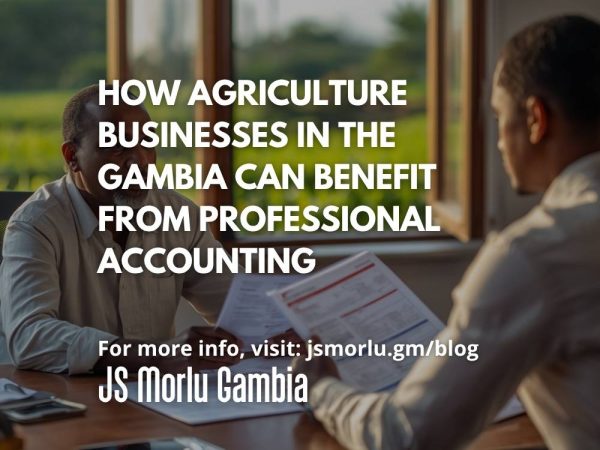
Agriculture is the backbone of the Gambian economy. It employs a significant portion of the working population, feeds families across the country, and generates income for communities in every region. Yet many agricultural businesses in The Gambia operate without the financial systems that would allow them to grow beyond a certain point — not because of a lack of hard work or farming knowledge, but because proper accounting has never been treated as a priority in day-to-day operations.
That gap creates a ceiling. And for agribusiness owners who want to expand, access financing, or build something that outlasts them, it is a ceiling worth understanding — and breaking through.
Why Agricultural Businesses Face Unique Accounting Challenges
Agricultural businesses face financial management challenges that are meaningfully different from those of a retail shop or a professional service firm. Income is seasonal — concentrated around harvest periods and dependent on conditions that vary from year to year. Expenses are spread unevenly across the calendar, with significant costs during planting and harvesting seasons and lighter periods in between. Assets include land, equipment, irrigation systems, and in some cases growing stock that needs to be valued and tracked differently from standard business assets.
These complexities do not make accounting impossible for agricultural businesses. They make it more important — because without a system specifically designed to handle seasonal variability and agricultural-specific asset categories, the financial picture an agribusiness owner sees is incomplete at best and actively misleading at worst.
The Practical Benefits of Professional Accounting for Agribusinesses
Season-by-season profitability tracking. A proper accounting system allows an agribusiness to compare performance across seasons, identify which crops or activities generate the best margins, and understand how costs are moving relative to revenue over time. This transforms financial management from a year-end exercise into an ongoing source of operational intelligence that improves every planting and selling decision.
Asset documentation and management. Agricultural businesses often hold significant assets — land, irrigation infrastructure, tractors, storage facilities, and processing equipment. Properly recording and valuing these assets gives the owner a much clearer picture of the total value of the business and directly supports decisions about maintenance, replacement, and future investment.
Access to financing. Banks and microfinance institutions in The Gambia consistently require organised financial statements before approving agricultural loans or credit facilities. With up-to-date records and regular financial reporting in place, an agribusiness owner can approach any financing conversation with the documentation required — rather than being turned away because the paperwork simply is not there.
Tax compliance. Agricultural businesses with employees and commercial-scale operations carry tax obligations that must be met accurately and on time. Professional accounting ensures these obligations are understood and handled correctly, without the risk of penalties, interest charges, or compliance issues that can seriously disrupt a seasonal operation.
You Do Not Need to Be a Large Operation to Benefit
A common assumption is that accounting support is only necessary once a business reaches a certain scale. In practice, the earlier proper accounting systems are established, the easier they are to maintain — and the more immediately useful the data they produce becomes. Even a small agricultural operation with a handful of workers benefits from knowing its actual cost of production, its real profit margin per crop, and its cash position at the end of each season.
Final Thoughts
Agriculture in The Gambia is hard, skilled, and essential work. The people who do it well deserve the full range of opportunities that proper financial management makes accessible — financing, credible financial records, the ability to plan for growth rather than simply react season to season. Professional accounting does not change what you grow or how you farm. It changes what your hard work is able to open doors to.
JS Morlu Gambia is a professional accounting firm and property valuation specialist based at Salameh Complex, Sukuta Highway, Brusubi, Kombo North, West Coast Region, The Gambia. We serve businesses, NGOs, and institutions across Banjul, Serekunda, Brikama, and throughout the country with structured financial reporting, compliance support, independent property valuation, and coordinated audit assistance designed to strengthen financial transparency and support sustainable growth.