
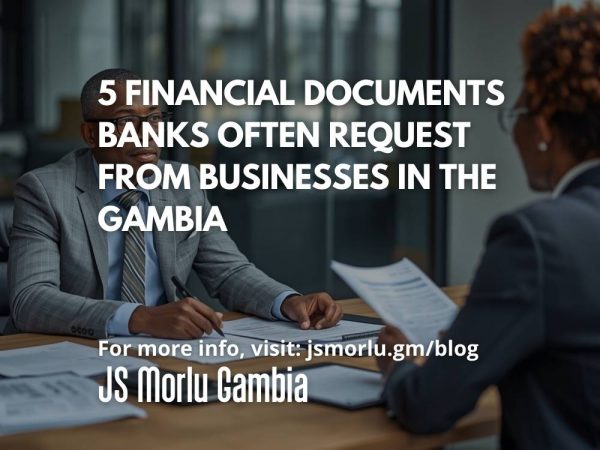
For many businesses in The Gambia, bank financing plays an important role in supporting expansion, purchasing equipment, or improving working capital. However, one of the most common reasons loan applications slow down is incomplete financial documentation.
Banks must carefully evaluate the financial stability of a business before approving financing. When the required financial information is not prepared in advance, lenders may request additional documentation, which delays the approval process.
Understanding which financial documents banks typically review can help businesses prepare more effectively.
Why Financial Documentation Matters
When a business applies for financing, banks need a clear understanding of its financial position. Financial documents allow lenders to assess:
- Revenue stability
- Profitability trends
- Cash flow management
- Existing financial obligations
- Overall financial discipline
Without reliable documentation, lenders may struggle to evaluate risk accurately.
1. Financial Statements
One of the most important documents banks review is a company’s financial statements.
These typically include:
- Statement of financial position (balance sheet)
- Income statement (profit and loss)
- Cash flow statement
These reports help lenders understand how the business generates revenue, manages expenses, and maintains financial stability.
2. Bank Statements
Banks often review several months of business bank statements to confirm cash flow patterns.
These statements help lenders assess:
- Revenue consistency
- Payment obligations
- Cash flow stability
Clear and reconciled bank records provide confidence that financial transactions are accurately recorded.
3. Accounts Receivable and Payable Records
Receivables and payables provide insight into how a business manages its financial relationships.
These records show:
- Outstanding customer payments
- Supplier obligations
- Payment cycles
Understanding these obligations helps lenders evaluate liquidity and financial management.
4. Business Registration Documents
Financial institutions also verify that businesses operate legally within the national regulatory framework.
Registration documentation confirms:
- Business ownership
- Legal structure
- Operational legitimacy
This information helps banks verify the identity of the business applying for financing.
5. Asset Documentation
In some cases, businesses may use assets such as property as collateral when applying for loans.
Supporting documents may include:
- Property ownership records
- Asset valuation reports
- Equipment ownership documentation
Clear documentation helps lenders determine the value of collateral.
Preparing Before Applying
Businesses that organize their financial documents before approaching a bank often experience smoother financing processes.
Helpful preparation steps include:
- Updating financial statements regularly
- Reconciling bank accounts
- Maintaining organized accounting records
- Ensuring registration documents are current
These practices help reduce delays during loan reviews.
Final Thoughts
Bank financing decisions depend heavily on financial transparency. Businesses that maintain clear financial records and structured reporting are better positioned when seeking funding opportunities.
Preparing these documents in advance allows lenders to evaluate applications more efficiently and helps businesses access financing with greater confidence.
JS Morlu Gambia is a professional accounting firm and property valuation specialist based at Salameh Complex, Sukuta Highway, Brusubi, Kombo North, West Coast Region, The Gambia. We serve businesses, NGOs, and institutions across Banjul, Serekunda, Brikama, and throughout the country with structured financial reporting, compliance support, independent property valuation, and coordinated audit assistance designed to strengthen financial transparency and support sustainable growth.