
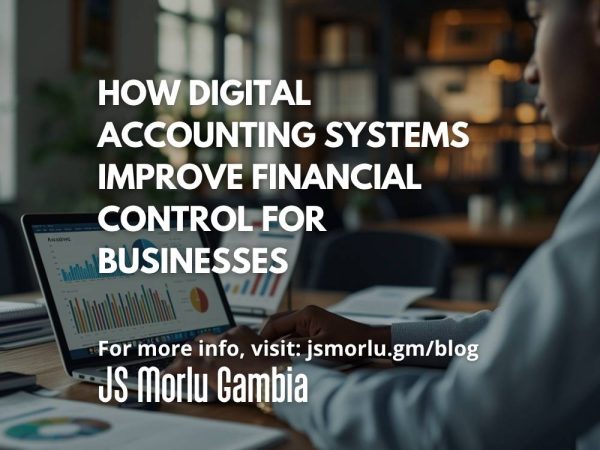
As businesses grow, financial management naturally becomes more complex. Transactions increase, operational costs expand, and business owners require clearer financial insight to make informed decisions. Many organizations initially rely on spreadsheets or manual bookkeeping to track financial activities. While these methods may work in the early stages, they often become inefficient as business operations expand.
Digital accounting systems provide businesses with a more structured and efficient way to manage financial information. By automating key accounting processes, these systems help organizations maintain clearer financial records while reducing administrative workload.
Limitations of Manual Accounting Methods
Manual bookkeeping systems often create several operational challenges. When financial records are maintained through spreadsheets or handwritten ledgers, errors can easily occur and financial reports may take longer to prepare.
Businesses relying on manual processes may experience:
- delayed preparation of financial reports
- difficulty tracking receivables and payables
- limited visibility into cash flow
- higher risk of calculation or data entry errors
- time-consuming reconciliation processes
As transaction volumes grow, these challenges can affect the quality and reliability of financial information.
Benefits of Digital Accounting Systems
Digital accounting systems streamline financial management by automating many routine accounting tasks.
Modern systems allow businesses to:
- record transactions automatically
- generate financial reports instantly
- track receivables and payables more accurately
- monitor cash flow patterns
- maintain organized digital financial records
Automation reduces manual work and helps accounting teams focus on financial analysis rather than repetitive administrative tasks.
Access to Real-Time Financial Information
One of the most valuable advantages of digital accounting systems is the ability to access real-time financial data. Instead of waiting until the end of the month to review financial performance, business owners can monitor their financial position whenever necessary.
Real-time insights allow businesses to:
- monitor revenue trends
- control operational expenses
- identify financial risks early
- adjust business strategies quickly
Having access to up-to-date financial information improves decision-making and operational planning.
Supporting Business Expansion
As businesses expand, lenders, investors, and regulators often require reliable financial information. Structured accounting systems make it easier to prepare financial statements and demonstrate financial transparency.
Organizations with well-organized accounting systems are better prepared to:
- apply for financing
- respond to audit requests
- evaluate business performance
- plan for future growth
A Stronger Financial Foundation
Digital accounting systems provide businesses with stronger financial control and better visibility into daily operations. By improving accuracy, efficiency, and reporting capabilities, these systems help organizations manage growth more effectively.
For many businesses in The Gambia, transitioning from manual bookkeeping to structured accounting technology represents an important step toward stronger financial management.
JS Morlu Gambia is a professional accounting firm and property valuation specialist based at Salameh Complex, Sukuta Highway, Brusubi, Kombo North, West Coast Region, The Gambia. We serve businesses, NGOs, and institutions across Banjul, Serekunda, Brikama, and throughout the country with structured financial reporting, compliance support, independent property valuation, and coordinated audit assistance designed to strengthen financial transparency and support sustainable growth.