
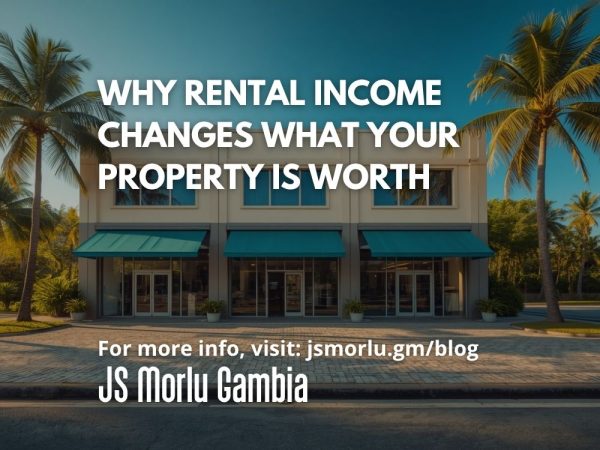
Modou owns a two-storey building with three shop units. He rents out two and uses one for his own business. When he asked a valuer for a figure, he expected the answer to focus on the land and the bricks.
Instead, the valuer asked for his rental agreements. Why would rent matter to the value of a building?
Many property owners are surprised by this. They assume a building has one fixed value based on its size and finish.
Why a Valuer Asks About Rent
A property that earns income is useful to its owner in two ways. It can be used, and it can pay. Buyers and lenders often care about what a building earns as well as what it looks like.
So the valuer looks at the rent being paid now, and at what similar units nearby could reasonably earn. This is one of the standard ways to assess an income-producing property.
Modou had never calculated what his building earned after costs. He knew the rent coming in, but not what remained once repairs and cleaning were paid. The valuer explained that this net figure is what investors care about.
How Rental Income Feeds Into the Number
The valuer starts with the yearly rent, then considers the costs of keeping the building running. These include repairs, management and, where relevant, periods when a unit sits empty.
What remains is compared with what buyers typically expect from similar investments. A building with steady rent from reliable tenants may be valued higher than a similar one with uncertain income.
That is one reason two buildings that look alike can be valued very differently.
Take two similar buildings in the same street. One has long-term tenants paying on time. The other has two empty units and a tenant who is often late.
A buyer would likely pay more for the first one, even though the walls and roofs are the same. The reliable income is part of what they are buying.
What Else Still Matters
Rent is never the only factor. Location, condition, size, legal title and recent sales of similar properties all play a part. Rental income is one piece of a bigger picture.
Modou’s valuer also noticed that one unit was rented well below the usual rate for the area. This was a clue that his income might not reflect the property’s full potential.
Legal and practical details count too. A valuer will usually check the title, the permitted use and whether leases are properly documented. Gaps in any of these can affect the figure.
The condition of the building also matters. A well-maintained property can hold its rent and attract better tenants. A neglected one may struggle to do either.
How to Prepare Before the Valuation
Gather your rental agreements, rent receipts and a list of running costs. If a unit was empty for a while, note when and why.
Clear records help the valuer reach a fair figure with less guesswork. Do you know what each of your units actually earns after costs?
It also helps to bring a simple list of the work you have done on the building, such as repairs, repainting or new fittings. Receipts or photos make this easier to show.
If any units are not rented, explain how you use them. A shop used by the owner is treated differently from one standing empty.
Using the Valuation Wisely
A valuation is a professional opinion at a point in time. Rents, tenants and the market can change, so it is worth reviewing the figure from time to time.
Ask your valuer to explain how the income was treated. Understanding the number helps you use it better, whether you are borrowing, selling or planning ahead.
Modou used his valuation to discuss a loan with his bank. Because the report explained how his rental income was treated, the conversation was short and clear.
If your rents are below the market level, the valuation may also help you plan. Review leases when they come up for renewal, and make sure any increase is fair and agreed in writing.
Know What Your Rental Property Is Really Worth
JS Morlu Gambia provides independent property valuation for owners, lenders and investors. We can explain how rental income, condition and location were considered, so the figure is clear and not just a number on paper. If you own income-producing property, a professional valuation can support decisions about lending, selling and planning ahead.
JS Morlu Gambia is a professional accounting firm and property valuation specialist based at Salameh Complex, Sukuta Highway, Brusubi, Kombo North, West Coast Region, The Gambia. We serve businesses, NGOs, and institutions across Banjul, Serekunda, Brikama, and throughout the country with structured financial reporting, compliance support, independent property valuation, and coordinated audit assistance designed to strengthen financial transparency and support sustainable growth.