
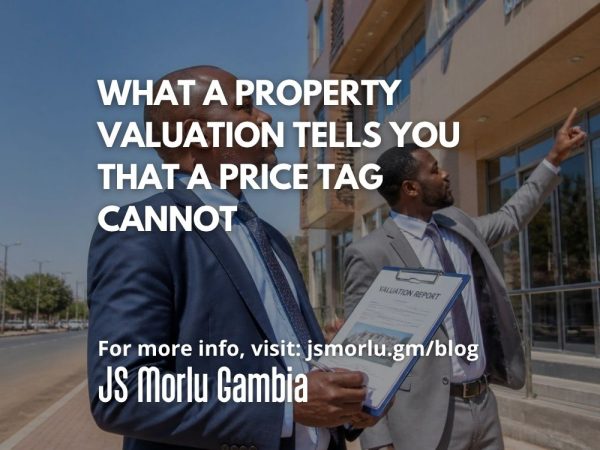
When a property is listed for sale in The Gambia, it comes with an asking price. That price reflects what the seller wants. It may be based on what they paid for the property, what a neighbour recently sold for, what they need to fund their next purchase, or simply what they feel the property is worth.
None of these factors necessarily have anything to do with the property’s actual market value. And that gap — between what a seller asks and what a property is independently worth — is where many buyers and businesses make costly mistakes.
A professional property valuation closes that gap. It replaces assumption with evidence, and opinion with documented methodology.
What a Price Tag Actually Tells You
An asking price tells you the seller’s starting position in a negotiation. Nothing more. It is not an assessment of the property’s current market value. It is not based on comparable sales data. It is not independently verified. And it is not a figure that a bank or investor will accept as evidence of value.
In a market like The Gambia, where property transactions are not always publicly recorded and comparable data can be difficult to access, asking prices can diverge significantly from actual market values. Properties in some areas are overpriced relative to recent transactions. In others, asking prices may not reflect recent infrastructure improvements that have increased values in the surrounding area.
Without an independent valuation, you have no reliable way to know which situation you are in.
What a Professional Valuation Actually Provides
A professional property valuation is a formal, documented assessment of a property’s market value at a specific point in time. It is prepared by a qualified valuer using recognised methodology and supported by evidence from the local market.
Specifically, it provides an assessment of the property’s physical condition and characteristics, an analysis of comparable transactions involving similar properties in the area, consideration of factors that affect value — including location, access, infrastructure, and permitted use — and a formal written report that documents the process and conclusion.
This is fundamentally different from an asking price. It is an independent, evidence-based opinion of value — one that banks, courts, investors, and auditors will accept and act on.
When the Difference Really Matters
The gap between an asking price and a professional valuation becomes most significant in three situations.
When applying for financing. Banks in The Gambia will not lend based on an asking price. They require a professional valuation, and they will lend a percentage of the independently assessed value — not the seller’s asking price. If the valuation comes in lower than the asking price, the maximum loan amount falls accordingly.
When making an investment decision. Paying above market value for a property means you are starting your investment at a loss. A professional valuation gives you a reference point for negotiation — and the confidence to walk away if the seller will not meet a price the market supports.
When recording property on your balance sheet. Financial statements require assets to be recorded at accurate values. Using an asking price or an informal estimate creates inaccuracies that affect the reliability of your financial reporting.
The Practical Value of Independent Assessment
A professional valuation does not just protect you from overpaying. It also gives you negotiating power. When you can demonstrate to a seller that an independent valuer has assessed their property at a specific value, the conversation about price moves from opinion to evidence. That is a much stronger position to negotiate from.
What This Means for You
Whether you are buying, selling, financing, or simply trying to understand the value of property your business holds, a professional valuation is the only reliable basis for that understanding. A price tag tells you what someone wants. A valuation tells you what it is actually worth.
In a market where property decisions involve significant capital, that distinction is worth acting on.
JS Morlu Gambia is a professional accounting firm and property valuation specialist based at Salameh Complex, Sukuta Highway, Brusubi, Kombo North, West Coast Region, The Gambia. We serve businesses, NGOs, and institutions across Banjul, Serekunda, Brikama, and throughout the country with structured financial reporting, compliance support, independent property valuation, and coordinated audit assistance designed to strengthen financial transparency and support sustainable growth.